building-maintenance9Werkks Team
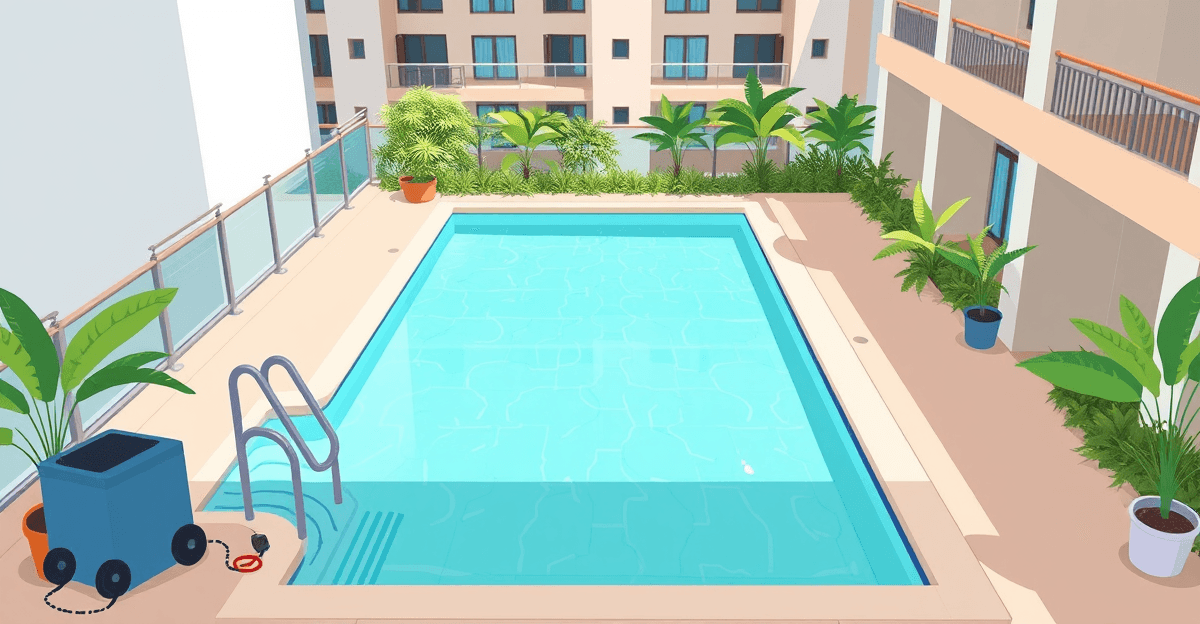
Last year, a condo pool in the east had to shut down for three weeks after an NEA inspection found chlorine levels dangerously low. Residents were furious. The MCST blamed the contractor. The contractor blamed late chemical deliveries. Nobody had been checking the daily readings properly. Entirely preventable. Swimming pool maintenance in Singapore condos is governed by a strict regulatory framework involving the NEA, the Building Maintenance and Strata Management Act (BMSMA), and Singapore Standard SS 556. For facility managers and MCST council members, understanding these requirements is not optional — non-compliance can result in pool closure orders, fines, and liability for waterborne illness outbreaks. With over 1,200 private condominiums across Singapore, most featuring at least one pool, proper maintenance is a core responsibility of every managing agent.
Key Takeaway: Singapore condo pools must meet NEA water quality standards (free chlorine 1.0–3.0 mg/L, pH 7.2–7.8), undergo monthly accredited lab testing, and be maintained under the MCST's duty of care as defined by the BMSMA. Daily operational checks and weekly professional servicing are industry best practice.
NEA Swimming Pool Maintenance Requirements in Singapore
The NEA regulates all swimming pools accessible to the public or residents under the Environmental Public Health Act (EPHA) and the Environmental Public Health (Swimming Pools) Regulations. Every condo pool in Singapore must hold a valid swimming pool licence issued by NEA.
Water Quality Standards
NEA mandates the following water quality parameters for all licensed pools:
| Parameter | Required Range |
|---|---|
| Free residual chlorine | 1.0 – 3.0 mg/L |
| pH level | 7.2 – 7.8 |
| Turbidity | ≤ 0.5 NTU |
| Total coliform | < 1 per 100 mL |
| E. coli | Absent in 100 mL |
These standards are based on Singapore Standard SS 556: Code of Practice for Swimming Pools, which provides detailed guidance on design, operation, and maintenance. Pool operators must conduct daily on-site testing of chlorine and pH levels, and arrange for monthly water sampling by an NEA-accredited laboratory.
Licensing and Inspection
All condo pools require a swimming pool licence, renewable annually. NEA officers conduct unannounced inspections to verify compliance. Common issues flagged during inspections include:
- •Chlorine levels outside the mandated range
- •Missing or incomplete pool log books
- •Non-functional dosing or filtration equipment
- •Inadequate safety signage or missing life-saving equipment
Failure to comply can result in fines of up to $5,000 per offence, pool closure orders, or licence revocation. Repeated offences under the EPHA may carry higher penalties.
MCST Obligations for Condo Swimming Pool Maintenance
Under the Building Maintenance and Strata Management Act (BMSMA), the management corporation (MCST) is legally responsible for the control, management, and maintenance of common property — including swimming pools, wading pools, jacuzzis, and associated plant rooms.
Duty of Care and Liability
The MCST owes a duty of care to all residents and guests using the pool. This includes:
- •Structural integrity — ensuring pool shells, tiling, and coping are free from hazards
- •Water quality — meeting NEA standards at all times
- •Safety equipment — providing life buoys, reaching poles, first aid kits, and CPR signage
- •Supervision — posting pool rules and ensuring lifeguard deployment where required
If a resident or visitor suffers injury or illness due to negligent pool maintenance, the MCST can face civil liability. Council members should ensure that adequate public liability insurance covers pool-related incidents.
Budgeting for Pool Maintenance
Pool maintenance is one of the larger recurring expenses in a condo's management budget. Typical annual costs for a standard 25-metre condo pool in Singapore include:
- •Weekly servicing contract: $800–$1,500/month
- •Monthly accredited water testing: $100–$200/month
- •Chemical supplies (chlorine, acid, algaecide): $300–$600/month
- •Equipment maintenance (pumps, filters, dosing systems): $2,000–$5,000/year
- •Annual pool resurfacing/retiling (sinking fund): $15,000–$40,000 every 8–12 years
MCSTs should allocate pool costs across both the management fund (for routine maintenance) and the sinking fund (for major repairs and equipment replacement). A well-structured preventive maintenance schedule ensures costs remain predictable and avoids emergency repair surcharges.
Still tracking swimming pool maintenance jobs in spreadsheets and WhatsApp?
Werkks schedules recurring maintenance, keeps photo records of every completed job, and shows live status across all your contractors and staff. Free for 14 days.
Weekly Swimming Pool Maintenance Checklist for Singapore Condos
A comprehensive weekly servicing routine should cover the following:
Water Chemistry and Treatment
- •Test and adjust free chlorine to 1.0–3.0 mg/L
- •Test and adjust pH to 7.2–7.8
- •Check total alkalinity (80–120 mg/L recommended)
- •Inspect and refill chemical dosing systems
- •Shock-treat pool if combined chlorine exceeds 0.5 mg/L
- •Add algaecide as needed (especially during monsoon season)
Filtration and Circulation
- •Check pump operation and flow rates
- •Inspect pressure gauges on sand or cartridge filters
- •Backwash filters when pressure differential exceeds 8–10 psi
- •Clean skimmer baskets and pump strainer baskets
- •Verify turnover rate meets SS 556 requirements (typically 4–6 hours for residential pools)
Physical Inspection
- •Vacuum pool floor and brush walls
- •Inspect pool tiles and grouting for damage
- •Check overflow channels and balance tanks
- •Verify all drain covers are secure and compliant (anti-entrapment)
- •Inspect pool deck surfaces for slip hazards
Safety and Compliance
- •Confirm life-saving equipment is present and in good condition
- •Verify pool rules signage is visible and legible
- •Check first aid kit supplies
- •Record all readings in the pool log book (required by NEA)
How Much Does Condo Pool Maintenance Cost in Singapore?
For a typical condominium with one 25-metre main pool and one wading pool, facility managers should budget $1,500–$2,500 per month for routine maintenance, inclusive of weekly servicing, chemicals, and monthly lab testing. This translates to roughly $18,000–$30,000 annually for operational maintenance alone.
Larger developments with multiple pools, lap pools, or hydrotherapy facilities will see costs scale proportionally. When quoting maintenance jobs, contractors should factor in pool size, bather load, equipment condition, and any additional features like water jets or heating systems.
Major capital expenditure items to budget in the sinking fund include:
- •Pool pump replacement: $3,000–$8,000
- •Sand filter media replacement: $2,000–$4,000
- •Retiling and resurfacing: $15,000–$40,000
- •Dosing system overhaul: $5,000–$12,000
Tropical Climate Challenges for Pool Maintenance in Singapore
Singapore's equatorial climate creates unique challenges for pool maintenance that facility managers must account for year-round.
High temperatures (averaging 27–31°C) accelerate chlorine dissipation, meaning pools require more frequent chemical dosing compared to temperate climates. Cyanuric acid (stabiliser) is commonly used in outdoor pools to reduce UV-induced chlorine loss, though levels must be monitored to avoid over-stabilisation.
Heavy rainfall during the monsoon seasons (November–January and June–September) dilutes chemical concentrations and introduces contaminants. After major storms, additional shock treatment and water testing are advisable. Overflow drainage systems must be kept clear to prevent flooding of the pool deck and plant room — a task that should feature in your mid-year building maintenance checklist.
High humidity promotes algae growth, particularly green algae in shaded areas and black algae in grouting. Regular brushing and preventive algaecide treatment are essential.
Choosing a Pool Maintenance Contractor in Singapore
When selecting a pool maintenance contractor, MCSTs and facility managers should verify:
- 1.NEA licensing — the contractor should hold a valid swimming pool maintenance licence
- 2.Track record — request references from other condominiums of similar size
- 3.Response time — clarify SLA for emergency callouts (equipment failure, contamination events)
- 4.Scope of work — ensure the contract covers weekly servicing, chemical supply, monthly lab testing, and equipment maintenance
- 5.Reporting — the contractor should provide monthly maintenance reports and maintain the pool log book
Tracking contractor performance against maintenance KPIs — such as water quality compliance rate, response time to callouts, and equipment uptime — helps MCSTs hold service providers accountable. Werkks simplifies job scheduling and invoicing for Singapore facilities managers, making it straightforward to coordinate pool servicing visits, track completion, and manage contractor payments in one place.
For managing agents handling multiple properties, having a centralised system to schedule recurring pool maintenance across all sites eliminates the risk of missed visits. Platforms like Werkks, alongside custom workflow tools from Adaptels, allow facilities teams to automate scheduling, capture on-site checklists digitally, and generate compliance reports without manual data entry.
Common Pool Compliance Issues and How to Avoid Them
Based on common NEA enforcement actions, these are the most frequent compliance failures in Singapore condo pools:
| Issue | Root Cause | Prevention |
|---|---|---|
| Low chlorine levels | Dosing pump failure, heavy bather load | Daily testing, backup dosing pump, regular pump servicing |
| pH outside range | Chemical imbalance, rainwater ingress | Automated pH controllers, post-rain testing |
| Missing log book entries | Staff oversight | Digital log book with automated reminders |
| Expired pool licence | Administrative lapse | Calendar reminders 60 days before renewal |
| Faulty drain covers | Wear and ageing | Quarterly inspection, immediate replacement |
Proactive maintenance — rather than reactive fixes — is the most cost-effective strategy. A well-documented preventive maintenance schedule reduces emergency callouts, extends equipment lifespan, and ensures continuous NEA compliance.
Summary
Swimming pool maintenance for Singapore condos requires consistent attention to NEA water quality standards, proper MCST governance, and rigorous weekly servicing routines. Facility managers who invest in structured maintenance programmes, qualified contractors, and digital tracking tools will minimise compliance risk, control costs, and keep residents safe.
Sources
Frequently Asked Questions
How often must swimming pools in Singapore condos be inspected?
NEA requires that swimming pool water quality be tested at least once a month by an accredited laboratory. In practice, daily on-site checks of chlorine residual and pH levels are standard for condo pools. MCSTs typically engage a licensed pool maintenance contractor to perform weekly servicing, which includes filtration checks, chemical dosing, and visual inspections.
What are the NEA water quality standards for condo pools in Singapore?
Under the Environmental Public Health (Swimming Pools) Regulations, pool water must maintain free residual chlorine between 1.0 and 3.0 mg/L, pH between 7.2 and 7.8, and turbidity not exceeding 0.5 NTU. Bacteriological standards require the total coliform count to be below 1 per 100 mL. Non-compliance can result in closure orders and fines up to $5,000.
Who is responsible for pool maintenance in a Singapore condo — the MCST or the developer?
Once the management corporation is constituted under the Building Maintenance and Strata Management Act (BMSMA), the MCST assumes full responsibility for maintaining all common property, including swimming pools. During the developer's initial maintenance period, the developer bears this responsibility. The MCST must budget for pool maintenance through the management fund and sinking fund contributions.
swimming pool maintenanceNEA complianceMCST requirementscondo maintenance singaporefacilities managementwater quality
Keep your maintenance records inspection-ready
Schedule recurring inspections, collect photo proof of completed work, and keep an audit trail of every job — free for 14 days. No credit card required.
Start Free TrialNo credit card14-day trialCancel anytime
Related Articles
building-maintenance
Lightning Protection System Maintenance for Singapore
A practical guide to lightning protection system maintenance in Singapore — SS 555 standards, inspection frequency, testing, and compliance for facility managers and MCSTs.
building-maintenanceSolar Panel Maintenance Singapore: Costs & Schedule
How often do solar panels need servicing in Singapore's tropical climate? Typical 6-month cleaning cycles, cost benchmarks, and a maintenance schedule for building rooftops.
building-maintenanceWater Feature and Fountain Maintenance for Singapore Properties
A practical guide to water feature and fountain maintenance in Singapore — covering algae control, pump servicing, mosquito prevention, NEA compliance, and MCST obligations.